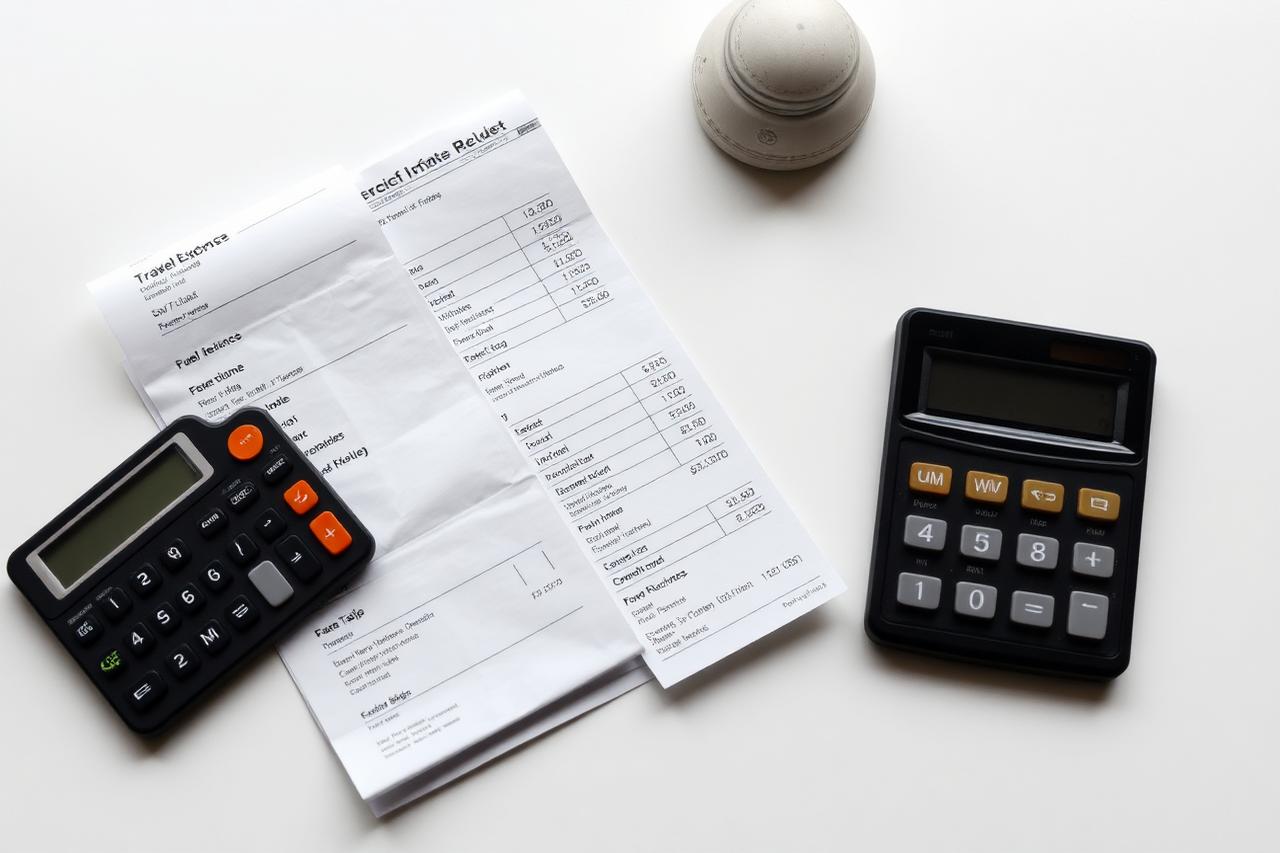
What counts as travel expenses?
The term "Spesen" is colloquial. For tax purposes, the costs of business travel fall into four categories: transport costs, additional meal expenses, overnight costs and incidental travel costs. Each category follows its own rules — only the additional meal expenses must always be settled at a flat rate.
Domestic meal allowances
| Absence | Flat rate |
|---|---|
| more than 8 hours | €14 |
| Day of arrival and departure on a multi-day trip | €14 each |
| 24 hours (full calendar day) | €28 |
What matters is the time away from home and the first place of work. For trips abroad, country-specific flat rates apply, published annually by the Federal Ministry of Finance; the relevant location is the place the employee reaches before midnight local time.
Deduction for meals provided
If the employer, or a third party at the employer's instigation, provides a meal, the daily allowance is reduced: by 20 percent for breakfast and by 40 percent each for lunch and dinner — based on the full daily allowance of €28. A hotel breakfast therefore costs the settlement €5.60, a business dinner €11.20.
Overnight stays and incidental costs
Overnight costs within Germany are generally reimbursed at the actual amount against a receipt. The employer may pay a flat rate of €20 per night tax-free if no invoice is available — this does not affect the deductibility as a business expense. Incidental travel costs such as parking fees, tolls, luggage storage or work-related phone calls are fully reimbursable against a receipt.
The three-month rule
Meal allowances are available for the same business trip at the same place of work for only three months, if the employee works there on at least three days per week. A break of at least four weeks restarts the period — regardless of the reason for the break.
Transport costs
For journeys with a private car, €0.30 per kilometre driven may be reimbursed tax-free, and €0.20 for motorcycles. Alternatively, an individual rate per kilometre based on actual vehicle costs is possible. Tickets for rail, air and public transport are settled against receipts.
Audit-proof settlement
- Document the reason for travel, destination, start and end with times.
- Note meals provided explicitly — including the hotel breakfast.
- Keep receipts in original form or as an audit-proof scan for ten years.
- Show reimbursements in the payroll account separately as tax-free and taxable.
- A written travel expenses policy creates clarity and limits case-by-case disputes.
Communicating with the employee
Explain deductions and rejected items in writing, referring to the policy. If a settlement is finally rejected or corrected, a dated and signed letter is the cleanest form of evidence.