

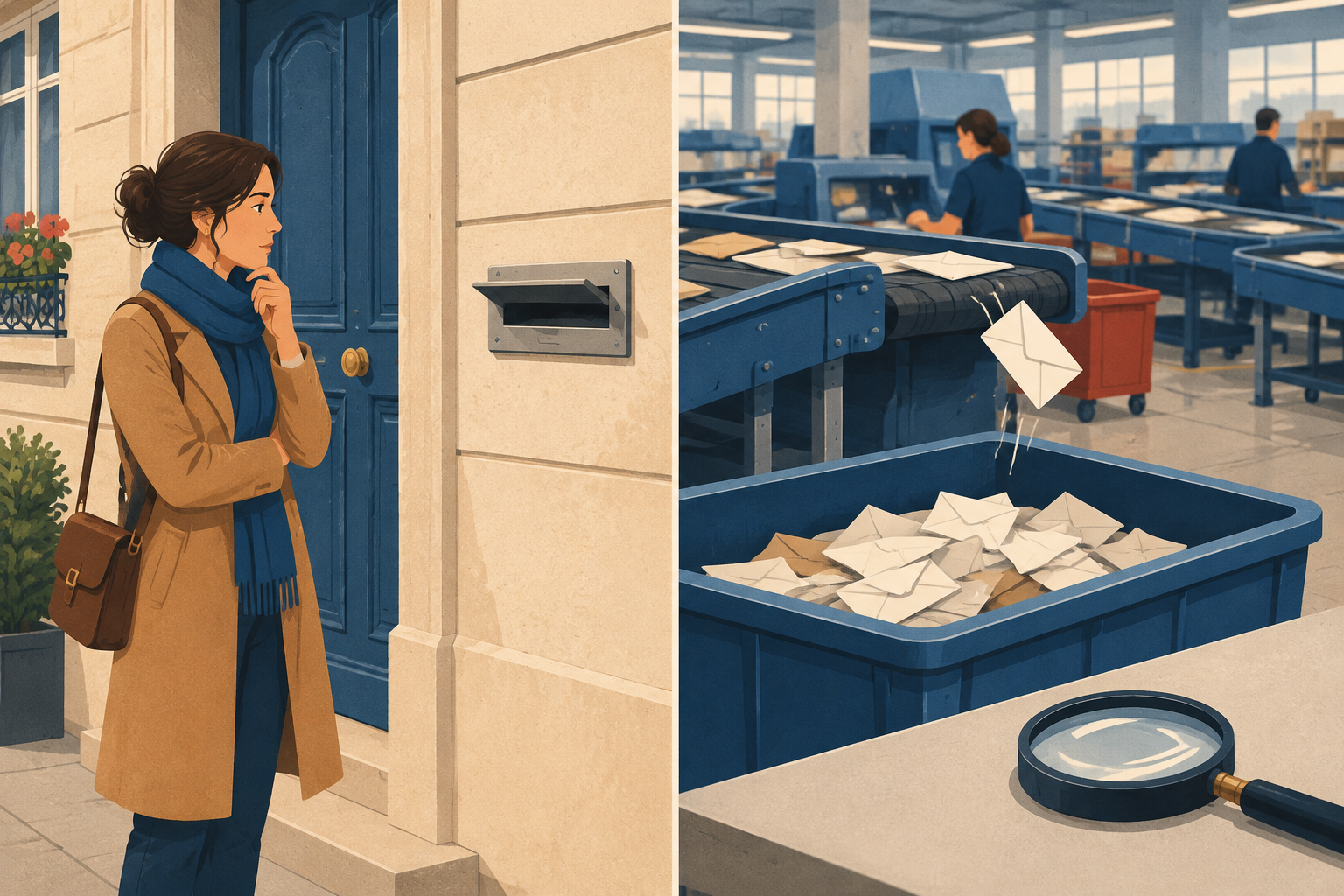
Is the letter really lost?
Most letters that "never arrive" are not lost but delayed or lying somewhere else. Work through this list before taking action:
- Check the delivery time. A letter within Germany usually arrives within three to four working days — a guideline, not a guarantee for any single letter.
- Check the mailbox. Including a second letterbox in the building, the reception desk or a company mailroom.
- Ask neighbours and building staff. Especially when a collection notice was involved or the carrier could not push the letter through the slot.
- Re-check the address. Missing floor or apartment numbers, a wrong postcode or an outdated line cause returns to the sender.
- Contact the sender. If you are waiting rather than having posted it yourself: only the sender knows when the letter was handed in — and holds a posting receipt for registered mail.
How long may a letter be on its way?
Since the 2024 postal reform, the rule for domestic mail is that, on annual average, 95 per cent of letters must be delivered by the third working day after posting and 99 per cent by the fourth. The key words are annual average — there is no delivery guarantee for your individual letter, and delays around holidays or during busy periods are normal.
| Route | Typical transit time (guideline) |
|---|---|
| Within Germany | 3–4 working days |
| Within Europe | about 3–7 working days |
| Worldwide | about 7–14 working days |
If a letter is clearly overdue — a rule of thumb is more than seven working days — the next step is a postal trace. For background on formats and postage, see our guide to letter types and postage.
Requesting a postal trace
Under § 32 of the German Postal Act (PostG), the postal provider must search for the whereabouts of an item at the request of the sender or the recipient once the regular transit time has been substantially exceeded — and must inform you of the outcome. In practice:
- Wait first. Deutsche Post recommends requesting a trace for letters only once the item has been in transit for more than seven working days.
- File the request. The trace form can be filled in online; for registered mail the item or receipt number is included.
- Have your details ready. Posting date, sender and recipient addresses, postage, format and, where available, the posting receipt.
The trace is free of charge. Without an item number — that is, for a plain standard letter — less can be traced; the more detailed your information, the better the chances of an outcome.
Rescuing a deadline when the letter is gone
This is where it becomes legally critical: for many declarations, the date of receipt matters (§ 130 of the German Civil Code) — for terminations, for example. Deadlines do not pause because mail gets lost. Fast action helps:
- Re-deliver immediately. Send the letter a second time — this time by registered mail — and point the recipient to it by email or phone in parallel.
- Hand it over in person. Against a receipt or with witnesses; the fastest and safest proof.
- Court deadlines. Missing a court deadline without fault can, in certain circumstances, be cured by applying for reinstatement into the previous status (§ 233 of the Code of Civil Procedure) — filed quickly, with reasons.
One exception exists: for a right of withdrawal, timely dispatch suffices under § 355 BGB. If you can prove that the letter was handed in for posting in time, the deadline is met even if the letter never arrives. Terminations are different: there, actual receipt counts.
What does the Post pay if a letter is lost?
For a standard letter without any add-on, the carrier's liability is limited to a small amount. For registered mail (Einschreiben), Deutsche Post's terms and conditions cap liability for lost valuables at €500 and for cash at €100. Courts ruled in 2025 that registered mail may not be advertised as a "secure delivery channel" while these liability caps are not made sufficiently clear.
Valuable items therefore do not belong in a standard letter. Insure valuable documents, send them by registered mail or hand them over in person.
Proving delivery next time
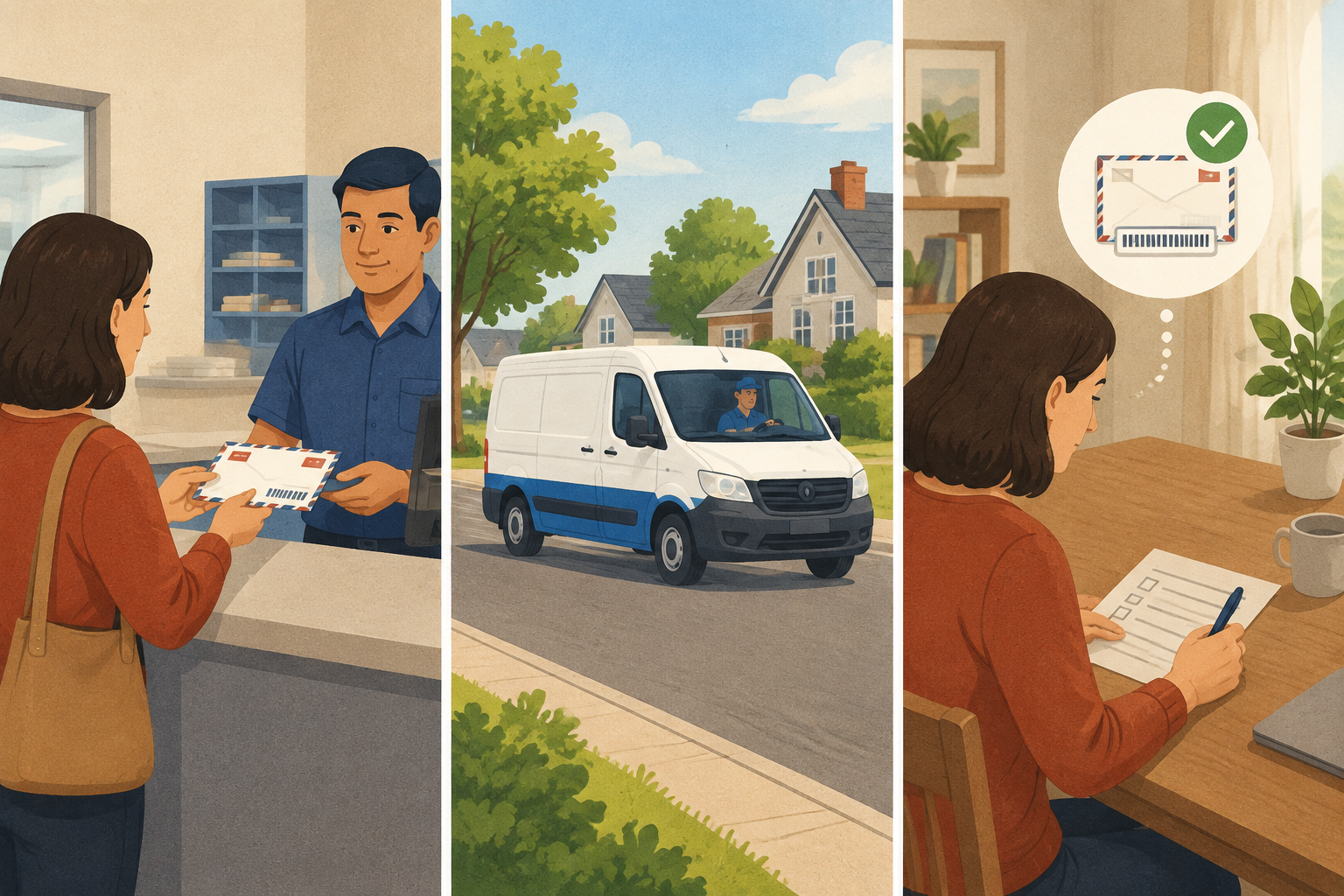
The lost letter is annoying, but it shows what counts: provable delivery. Proven tools are the drop-off registered letter (Einwurf-Einschreiben, documented insertion into the mailbox), registered mail with return receipt, hand-over against a receipt, or service by a bailiff. German case law treats a drop-off registered letter as received on the day after insertion, unless the recipient can show that they overlooked it or were prevented from taking notice. Which variants hold up in a dispute is explained in our guide on proving a letter was delivered.
Sending important mail safely in future
The best protection against lost mail starts before posting:
- Check the address completely — including floor and apartment number; the details are in our addressing guide.
- Plan lead time. Allow three to five working days, and considerably more before critical deadlines.
- Keep a copy. Photograph the document together with the posting date — for follow-up questions and evidence.
- Use registered mail for value. It costs more, but it documents posting and drop-off.
If you write letters regularly, there is a shortcut: in the briefsende.de letter editor you type the text, and the letter is printed, enveloped and franked — €2.99 including postage for up to three pages. Secure critical deadlines additionally by registered mail. How to structure the content itself is explained in our DIN 5008 guide.